

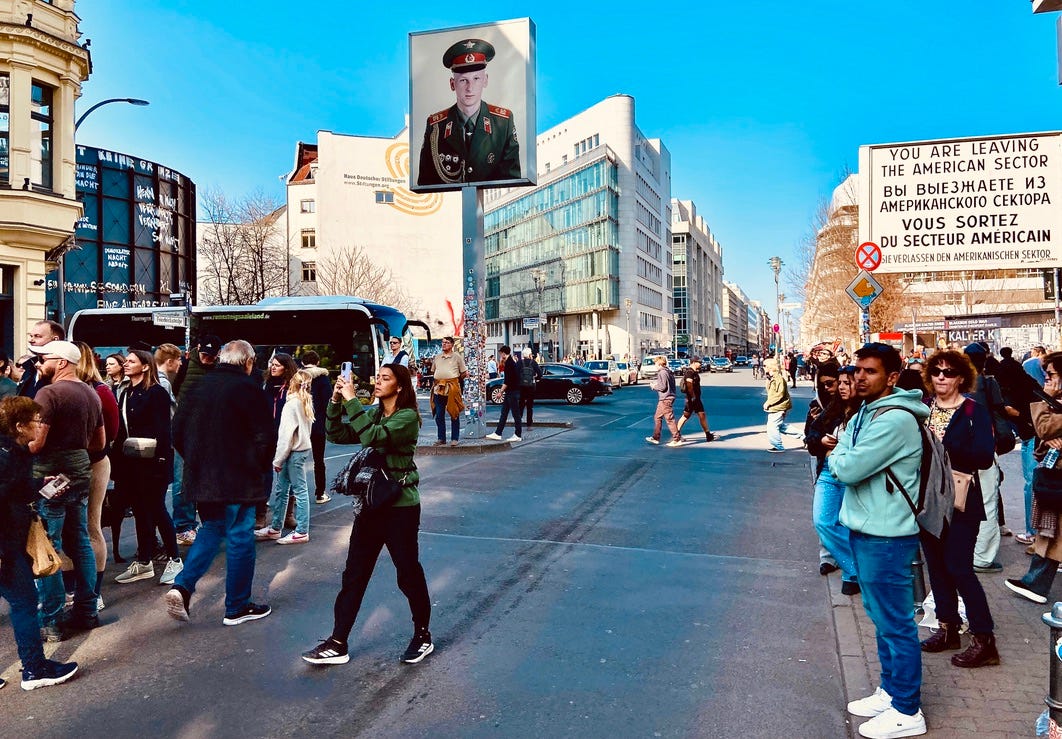
International Women’s Day 2025. At Checkpoint Charlie, in a pose that forever resembles a picturesque postcard, East Berlin meets West Berlin, and vice versa. It is 1961 and the moving image is that of a militarized traffic circle. We take time to pause and reflect on the site’s place in our knowledge production and its position as the single most enduring and representative symbol of the Cold War.
During the Berlin Crisis of 1961, American and Soviet tanks jammed this street, lined up with their gun barrels aimed at one another. It was a bitter foretaste of the military escalation that, with the Cuban Missile Crisis the following year, painted a sordid picture of what the world might have become if the nuclear arms race had led to nuclear annihilation.
In Berlin, NATO and the Warsaw Pact eyeballed each other in a tense standoff: a militarized version of the Seinfeld contest episode, where the will and ability to be, or not to be, Master of your Domain epitomized the difference between winner and loser. The Berlin crisis subsided once political leaders grasped that the geopolitical and human consequences of firing a single tank round were simply incalculable; in their separate worlds, they remained Masters of their own Domains, albeit mostly as potent symbols of an obsession with possessing armaments.
Today, remnants of the demolished Berlin Wall and Checkpoint Charlie draw tourists en masse, and Cold War historical capitalism accounts for a large portion of the German capital’s tourism economy.1 We line up behind authentic sandbags on the West Berlin side and smile at camera lenses positioned in what was once East Berlin. Souvenir shops offer “certified” wall fragments, posters featuring iconic photographs, fridge magnets, and T-shirts—including those bearing John F. Kennedy’s winning smile and famous quote: “Ich bin ein Berliner.” Of course, I give in to the urge to purchase the last mug that sports NATO’s comforting logo.
At street corners, chain-smoking men operate stalls that offer retro commodities: Cold War relics in all forms, alleged war medals from Red Army soldiers, fur hats bearing the hammer and sickle, and US dollar bills printed in the “standoff” year of 1961. Neither the weather-beaten vendors nor the souvenir shop staff seem inclined toward lengthy conversations; it is all about turnover and movement. No one can blame them, really. Too many questions and too much cold talk risk breaking the spell—that feeling of not quite knowing what year it is, what might happen next at the traffic circle, or what world awaits a block away. As long as no one points at the mirror, the world appears exactly as it looks. The emperor strolls around us, smiling with shining white teeth. We all enjoy the nudity.
At a café overlooking Checkpoint Charlie, strolling visitors and Berliners slurp coffee in the welcoming March sunshine. A couple airs a relationship grievance while sharing a cigarette, surrounded by murals depicting the Berlin Crisis of 1961, lined-up tanks, and armed NATO and Soviet soldiers.
“You have to understand that I’m only defending myself when you say things like that,” he says.
“But I’m doing exactly the same thing you are,” she says.
“I’m just defending myself,” he says.
“So am I,” she says.
From the nearby fenced-in food market, Ace of Base’s “Beautiful Life” blares out over Checkpoint Charlie. Life goes on. In the past. In the present. Whenever. Forever.
Aimée Plukker (2025) “Economic Miracle or Dream State?” Radical History Review (2025, No.151, pp.73–103).