

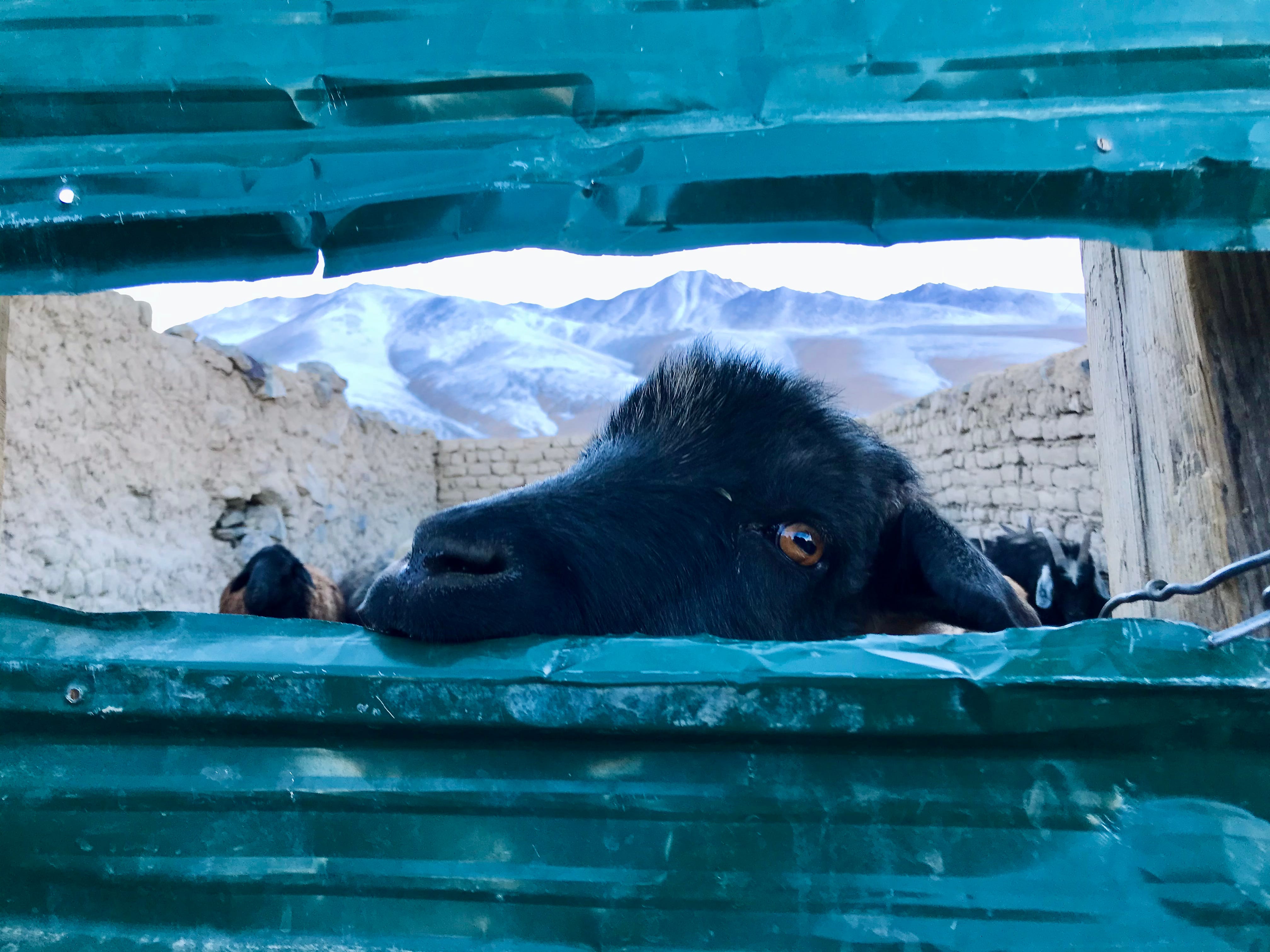
By the time the wolves came down from the slopes, snow had covered the pastures for months. Rustam, a livestock herder from the eastern Pamirs, drove the flock of sheep farther across the white field, scanning the emptied land and the ridges under a darkening afternoon sky. He carried only a stick and was only accompanied by his dog. No rifle, no knife, nothing you could call protection. The dog, an old and half-lame friend for many years, still hurled itself at the pack, desperate to fend off the vicious attack.
“He fought bravely and was badly injured,” Rustam recalls. “I was also injured. But we got away. And the sheep survived.”
The attack was swift and was over just as quickly. There was no time to hide, no time to run, let alone cry for help. What unsettled Rustam most this time was that the wolves did not first aim for the sheep. Instead, they had come for him.
“That was new,” he says. “It happens more often nowadays than it used to.”
It is midwinter in Gorno-Badakhshan, the autonomous region in eastern Tajikistan, and the last attack still wander around somewhere inside Rustam’s body, occupying space in his memory chambers and haunt his dreams. In the summer, he and his wife move higher up the slopes and pitch their yurt where the valley opens up the world and the heat eases under a clear-blue sky. Here, life offers almost no middle register. It is punishingly hot or bitter with cold, and in either season survival fills the day so completely that there is scarcely room for anything else.
Winter in the Pamirs now feels less like a season than an ordeal with no fixed rules. Bulunkul is a village that stands 3,700 metres above sea level. The nearest town, Khorog, lies in one direction; China’s Xinjiang border is closer at hand, further down the road. When the snow settles, its white veil usually covers the ground for months. The nearby lake freezes over. The world shuts itself and gives nothing away but a waking state of waiting. The earth is white, hard, and nearly undistinguished. At –50°C, breathing hurts. The sensation of time and place gets warped. People speak of getting through not just the winter, but the next moment.
Expect for the children, who play outside the one-storey houses and yurts in thin slacks and tracksuits. The other day, the temperature reached –56°C, the lowest of the year. The kids?
“We played outside, as always,” a group of children assures me. “It was sunny!”
In Bulunkul, the herders speak about wolf attacks with a fatalism that is not quite resignation but bordering to practical acceptance. “If they come, they come,” laments an older man. Hunger drives the wolves, but hunger is nothing new here—deprivation has a history in these mountains. Since the collapse of the Soviet Union, attacks on livestock have increased across Central Asia, bound up with the political and economic upheavals that followed independence. In Tajikistan, those upheavals became civil war. The Pamirs, a stronghold of the losing side, were left with the long afterlife of defeat: neglect, distance, and the slow privatisation of risk.[1]
The Pamir Highway, the only road in and out of Gorno-Badakhshan, snakes along uneven mountain slopes above the rushing Panj River, along the Afghan border. In the south-east, trucks move between Xinjiang, Khorog, and Dushanbe, carrying the ordinary cargo of survival and, sometimes, the ingredients of the illegal trade that secure income and purpose along the old frontier routes. Little of that passing commerce, however, remains in the region, not even the opium that serves the Russian market further north. It moves through the region more than into it.[2]
Rustam’s own life is intertwined with the Pamirian region’s historical contexts and geopolitical happenstances. During the Soviet war in Afghanistan, he rushed with supplies towards the borderlands along the Wahkan corridor. Then, when the war ended, the Soviet Union had armed itself to death and started to break apart—and whatever stability that had existed and provided a social contract in the Pamirs vanished with it. “First there was Soviet life, then there was civil war, and after that—there was nothing,” says Rustam.[3]
For all the semantics of development and pledges of a brighter tomorrow that trails the Belt and Road Initiative and the Tajik state’s infrastructure promises, it is the wolves that remain the primary issues for the residents of Bulunkul. The wolves have grown into a power-player whose skirmishes and attacks influence life in a way that is direct, physical, and without any mediation. The wolves cross the threshold into people’s lives along paths unknown to man—and yet, few speak of the intruders with any sign of hatred or bitterness. The damage caused by wolves is real, but so too is the sensation that the wolves merely answer to the name of game and man-made conditions established outside their sphere of influence.[4]
As one Kyrgyz herder puts it, the civil war emptied the slopes of the animals that the wolves used to prey on, and the ecosystem that sustained the wildlife has never really returned. “So this is our own doing,” he laments.
Tajik independence in the early 1990s also dismantled the economic and social systems that had woven some balance between people, livestock, and predators. Fodder provision, vaccination programmes, fixed grazing zones, and organised culls; these issues and concerns was a collective headache that formed a social contract between herder and the state. Now, without any lingering welfare program to speak of, herders must travel far for pasture and find themselves more and more often on grounds where the wolves roam.
Climate change has made the pattern harsher still. Summers scorch the mountain populations while the winters become ever-longer and grows ever-more erratic and unpredictable. All living beings in the Pamirs—human, livestock, wild animals, plants—do what they can to adapt to conditions and hardship that no longer remain the same from one year to the next.[5]
Rustam scrapes his boot against the frozen ground while the sheep poke around in the snow. The old dog stays close, observing the slopes with experienced eyes. Nothing can be dug up now—not roots, not grass, nothing. By late afternoon, the light is already draining behind the saw-like peaks, and it’s time to herd the animals back to the village. There, they will be fed with fodder purchased in Khorog or Dushanbe. The salty pasture grasses the sheep know and like is buried deep beneath the winter crust, unretrievable for them. Many refuse to touch the Khorog and Dushanbe fodder and simply thin out, weaken, and become easier prey when the wolves strike.
At dusk, villagers make their way to the communal well, carrying empty buckets and plastic bottles. Along the gravel road, I pass by a few parked Ladas whose owners are still tinkering with them in the indescribable cold. Many of these cars were brought to the Pamirs during the Soviet period, and up here the Lada is described as the best option for the Pamirian winters. In a place where the nearest mechanic is far away, you need to rely on a vehicle that is easy to fix and fiddle with. “We rely on ourselves up here,” says Jurij, a Kyrgyz herder. He seals a window on his Lada truck and observes the driver’s cabin. “Old cars,” he adds, “don’t drink as much petrol as new ones, and you can fix them with a screwdriver. It’s a lifeline.”
By full dark, the villagers withdraw into their low houses and yurts below a wide, severe sky. We lay down on mattresses, under blankets and quilts in a ring around the stove, arranged for warmth more than comfort. Sometime after midnight, there is sound of activity outside the house, restless and sturdy. Through a break in the low cloud, a smear of starlight offers a sudden beacon of light—but beyond the sole window of Rustam’s house there is nothing to see.
“Wolves,” he says and leans forward to feed the stove with more tinder. The fire cracks and a gust of heat fill the room. “They stroll into the village at night and have a look around. They map out our whereabouts and then return to the mountains.”
[1] Teiji Wataname, Shigeyuki Izumiyama, Leba Gaunavinaka & Maksat Anarbaev (2010) “Wolf Depredation on Livestock in the Pamir,” Geographical Studies (No.85, 2010).
[2] Danieli, F. De (2018) “Drugs and corruption in former Soviet Central Asia” (pp.263–273), in: Handbook on the Geographies of Corruption. Cheltenham: Edward Elgar Publishing.
[3] Davis, C. M. (1990) ”Economic influences on the decline of the Soviet Union as a great power: Continuity despite change,” Diplomacy & Statecraft, 1(3), 81–109.
[4] Ghoddousi, A., Eggers, J., Kirchner, K., Cornu, L., Kholmatov, I., Kubanychbekov, Z., Mirzoev, M.N., Sultanbaeva, K., Zhumabai Uulu, K., Baumann, M. and Michel, S. (2026) “Snow leopards, prey, and pastoralists: Understanding the impacts of climate change on human–wildlife coexistence in Central Asia,” Ambio, 55(5), pp.1079–1095; Sidle, R.C. (2020) “Dark Clouds Over the Silk Road: Challenges for Mountain Environments in Central Asia,” Sustainability,” 12(22), pp.9467.
[5] Xenarios, S., Gafurov, A., Schmidt-Vogt, D., Sehring, J., Manandhar, S., Hergarten, C., Shigaeva, J. and Foggin, M. (2019) “Climate change and adaptation of mountain societies in Central Asia: uncertainties, knowledge gaps, and data constraints”, Regional Environmental Change, 19(5), pp.1339–1352.